
Left Out? Centre-left political parties and the role of Taiwan in Australian and British foreign policy
This paper explores the extent to which Australian and British parliamentarians view Taiwan as the “most dangerous place on earth? (The Economist, 2021), addressing a notable knowledge gap in existing scholarship on how two of the United States’s two key allies and two members of the AUKUS Indo-Pacific security pact frame and approach Taiwan in foreign policy debates. Furthermore, this paper finds that despite notions of a persistent bipartisanship in Australian and British foreign policy on issues of security, centre-right politicians in Canberra and London are significantly vocal in raising Taiwan in foreign policy debates than their centre-left colleagues, posing questions over how resilient Australian and British support for a prospective American response to an escalation in the Taiwan Strait, as Taiwan’s de-facto security guarantor, may be. Where both in Canberra and London centre-left parties, the Australian Labor Party and the Labour Party, remain in power until at least 2028, Brandon Taylor’s assertion that Australia would “almost certainly follow” (Taylor, 2022, p.132) Washington in the defence of Taiwan, and Bristow and Jones’ argument that London would “reflexively support the United States in a crisis or conflict over Taiwan (2024, p.70) appears uncertain.
This paper focused on the quintessential importance of language in the elicitation of foreign policy ‘issues’, where interpretations and discourses shape certain foreign policy issues and avenues as essential and others as irrelevant (Campbell, 1993). Taiwan is particularly amenable to an interpretivist approach to foreign policy, for Taiwan’s role in the international system is defined by discourse, where Taiwan is in essence a “philosophical” (Brown & Wu, 2019, p.xxii) issue, defined by the dominant discourses attributed to what exactly Taiwan ‘is’, emanating from the Taiwanese themselves, as well as discourses from Washington and Beijing. To that end, in scrutinising the discourses afforded to Taiwan by Australian and British politicians, the extent to which Taiwan and cross-Strait relations are framed as merely ‘a quarrel in a faraway country, between people of whom we know nothing’ or as ‘part of the main’ quintessential to Australian and British foreign policy and security is essential to this paper. As such, parliamentary references afforded to Taiwan in the lower houses of Australia and Britain’s parliament were studied, by way of a discourse analysis, over a twenty year period, from 2004 to 2024, so to understand how Taiwan is framed and by whom, centre-right or centre-left politicians.
From Democracy to Security
Crucially, the manner in which Taiwan was elicited was essential to the extent to which bipartisanship within parliamentary debates arose. Indeed, in Australia in 2004 Members of Parliament (hereafter MPs) from both the Australian Labor Party (hereafter ALP) and the Coalition spoke warmly about the development of democracy in Taiwan. ALP MPs Michael Danby and Leo McLeay celebrated the resilience of Taiwan’s democracy as highlighted by a third successful Presidential Election, although curiously neither MP spoke of the assassination attempt on March the 19th in Tainan, joining Coalition colleagues in marking Taiwan’s democratic transition. Moreover, the emergence of a distinct Taiwanese identity was noted by Danby, arguing that “people in Taiwan … see themselves as distinctly Taiwanese” (Commonwealth, 2004, p.26993) whilst McLeay noted that a ‘new’ Taiwan had emerged, distinct from “the old KMT regime” (Commonwealth, 2004, p.3097). This bipartisan support for Taiwan, and Taiwanese democracy, would however dissipate in Australian foreign policy debates by 2024, where it would be centre-right MPs from the Coalition who would most frequently reference Taiwan, primarily as a security concern. Indeed, in 2024 two Labor MPs, Julian Hill and Luke Gosling referenced Taiwan’s Presidential Election of January of that year, and their respective visits to the inauguration of Lai Ching-te echoing the willingness to discuss Taiwan’s democracy of 2004. Yet, when Taiwan was framed primarily as a security issue, amid bellicose Chinese signalling and military exercises, Coalition MPs would dominate debates, tying Taiwan’s defence directly to AUKUS and Australia’s ANZUS alliance with the United States that commits Australia alongside the United States in ensuring security in the Pacific (Commonwealth, 2024, p.716; Commonwealth, 2024, p.709; Commonwealth, 2024, p.915).
Intriguingly the reticence, amongst centre-left MPs, to openly support Taiwan’s security, when raised in close connection to the foreign policy of the United States speaks to a broader, ideological shift in Australian foreign policy, between those Australians who see Australia’s most important relationships as emanating from the ‘Anglosphere’ and those who see Australia as a vital feature of Asia, as an emerging ‘Asian middle power’, with the ALP often aligned with the latter.
Legacies of the Special Relationship
Crucially, this distinction is echoed in British foreign policy debates, where a hesitancy in following foreign policy avenues championed in Washington has arisen amongst Labour MPs, particularly given it was the Labour government of Tony Blair that led Britain into war in Afghanistan and Iraq alongside the United States. As such, when Taiwan was framed as a ‘security issue’, closely tied to the Britain’s partner in the so-called ‘special relationship’, Labour MPs were notably in their absence in parliamentary debates dominated by Conservative MPs who consistently raised the spectre of war in the Taiwan Strait. Moreover, echoing the identity distinctions in Australia, Labour MPs were hesitant to follow the framing of Taiwan as an issue for a ‘Global Britain’, which in unsubtly alluding to Britain’s colonial history, poses Britain not as a European power but as a world power, closely aligned with the United States, as such in a parliamentary debate in March 2024 entitled ‘Taiwan Strait’ (HC Deb, 2024), no Labour MP spoke, despite MPs from all other major parties contributing to the debate.
An American Issue or a Vibrant Democracy?
Thus, this paper finds that centre-right parties are considerably more comfortable eliciting Taiwan in foreign policy debates in both Australia and the United Kingdom than their centre-left colleagues. This relates to an apprehension amongst centre-left MPs in both countries about the risks posed by following American foreign policy objectives, where Taiwan is framed in essence primarily as an ‘American obsession’. Yet, when Taiwan’s democracy arose in debates, bipartisan praise was forthcoming in Canberra in London. As such a challenge arises in Taipei, in disputing simplistic framings of Taiwan as merely a pawn in Sino-US great power competition, whilst further reinforcing the singular importance of Taiwan’s democracy and identity, both of which face considerable threat by an increasing assertive and entrenched authoritarian China.
References
Brown, K., & Wu, K. (2019). The Trouble with Taiwan: History, the United States and a Rising China. Zed Books.
Bristow, A., & Jones, C. (2024). UK Agency on the Issue of Taiwan. Asia Policy, 19(2), 65-76. https://doi.org/10.1353/asp.2024.a927089
Campbell, D. (1993). Politics Without Principle: Sovereignty, Ethics, and the Narratives of the Gulf War. Lynne Rienner Publishers.
Commonwealth, Parliamentary Debates, House of Representatives, 13 February 2024, 709 (Andrew Hastie) (Austl.) https://www.aph.gov.au/Parliamentary_Business/Hansard/Hansard_Display?bid=chamber/hansardr/27602/&sid=0104
Commonwealth, Parliamentary Debates, House of Representatives, 14 February 2024, 915 (Andrew Hastie) (Austl.) https://www.aph.gov.au/Parliamentary_Business/Hansard/Hansard_Display?bid=chamber/hansardr/27604/&sid=0168
Commonwealth, Parliamentary Debates, House of Representatives, 13 February 2024, 716 (Melissa McIntosh) (Austl.) https://www.aph.gov.au/Parliamentary_Business/Hansard/Hansard_Display?bid=chamber/hansardr/27602/&sid=0110
Commonwealth, Parliamentary Debates, House of Representatives, 23 March 2004, 26993 (Michael Danby) (Austl.) https://parlinfo.aph.gov.au/parlInfo/search/display/display.w3p;query=Id%3A%22chamber%2Fhansardr%2F2004-03-23%2F0088%22
Commonwealth, Parliamentary Debates, House of Representatives, 12 August 2004, 3097 (Leo McLeay) (Austl.) https://parlinfo.aph.gov.au/parlInfo/search/display/display.w3p;query=Id%3A%22chamber%2Fhansardr%2F2004-08-12%2F0296%22
HC Deb (25 Mar. 2024) (747) col. 1363, https://hansard.parliament.uk/Commons/2024-03-25/debates/EE8B7ADC-896B-4AF5-9DA4-A0EDB0BD9467/TaiwanStrait?highlight=taiwan#contribution-ADEBDFBF-3F9E-4B11-94FD-5FABC75EC363%20
Taylor, B. (2022). Taiwan: What Could, Should and Will Australia Do?. The Washington Quarterly, 45(3), 131-146. https://doi.org/10.1080/0163660X.2022.2126113
The Economist. (2021, May 1). The Most Dangerous Place on Earth. https://www.economist.com/leaders/2021/05/01/the-most-dangerous-place-on-earth
Contributor Bio
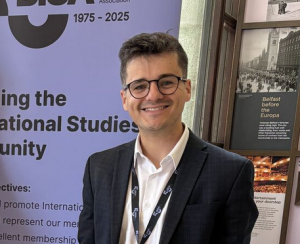
Max Dixon is a PhD student at the University of Portsmouth, studying British foreign policy and Taiwan between 1996 and 2021 funded by the South Coast Doctoral Training Partnership.
His research interests include British historic and contemporary approaches to East Asia and the role of language in the construction of British foreign policy.