
Research and Publication Grant Awardee 2024
In mid-2023 I submitted my dissertation and finally had time to think through what my next project would be. My interest in migration was growing. As an overseas student who had been living abroad for the past five years, it seemed natural that I would begin to grow an interest in migration literature in general. At the same time, in Taiwanese society, public interest in Southeast Asian migrant workers was growing. The popularity of Port of Lies (八尺門的辯護人), a TV series about a migrant fishermen mutiny airing in 2023, suggested that the existence of migrant workers, perhaps hitherto having only interested policy makers and NGO sectors, was beginning to become more appealing to the wider public. The appearance of the TV series made me recall the encounters I had with migrant workers and marriage immigrants – indeed there have been many, but hitherto I had not pieced them together as a research topic. I recalled a Vietnamese bistro that I frequented around my rented place in Dadaocheng; the live-in domestic worker who I once saw attending the bed of my friend’s grandfather; the bahn-mi food stand that I hope is still there in my hometown; and the migrant workers who relax in the lobby of Taipei Main Station on weekends.
In July 2023, my interest in Southeast Asian migrant workers finally had a chance to turn into a research project. I was admitted into the workshop “Soft Power, Indonesia, China: Histories and Humanities” in Malang, held jointly by the University of Sydney and Universitas Muhammadiyah Malang. In the workshop, I presented my preliminary research on the writings of Indonesian migrant workers. As a literary scholar who does not know Bahasa Indonesia, my primary data comes from the anthologies of the Taiwan Literature Award for Migrants 台灣移民工文學獎. The award has been running since 2014, with a pause during the two years of the Covid pandemic. Up to 2024, it has produced eight anthologies. The award invites Taiwan’s migrant workers, whose nationalities are Indonesian, Vietnamese, Myanmarese, Philippine and Thai, to submit literary pieces for the award. Judged by Mandarin-speaking Taiwanese literary authors, the submissions have to be translated into Chinese. Further, the award has a strong ethical imperative to promote a broader understanding of migrant workers among the Taiwanese public. As such, the Southeast Asian migrant worker literature in Taiwan is a translated literature.
The translated condition of this literature reflects the limit of this award. Despite the organisers’ good intention and the award’s alignment with the ideal of multiculturalism underlined by Taiwan’s New Southbound Policy, the award is perpetuated by a neocolonial gaze. My chapter “The Stratified Other and Unlikely Narrator” explains that the system of this award – focusing on its selection criteria including the judges’ commentary – imposes a neocolonial gaze on the literary entries, particularly through the judges’ notions of Taiwanese literature. The chapter identifies three positions underpinning the judges’ commentary, which define the entries’ inclusion into Taiwanese literature (or not). Measured against the judges’ notions of Taiwanese literature, the winning pieces suggest that ‘proper’ Southeast migrant literature should be marked by a reportage style, by its aesthetic value (though the translation process makes it hard to attribute this value to authors), and its marginalised position (ironically enough, Taiwanese literature’s inclusion in world literature regularly makes a similarly minoritising claim).
Moreover, conducting a close reading of two winning pieces by Indonesian female author Erin Cipta, from 2014 and 2015, about live-in workers, the chapter argues that the narrators’ positions as well as the reportage style embody what Lan Pei-chia characterises as “the stratified ethnic other” in Global Cinderellas. The narrators in Cipta’s short stories are stratified ethnic others who occupy a marginal narrative position. To be specific, their narrative position evokes what Wayne Booth describes as the “undramatised narrator” in Rhetoric of Fiction. Viewed through the eyes of the undramatised narrator, readers experience the stories as if ‘unmediated,’ as the narrator does very little to personalise herself. Readers are given very little information about the narrators. In the case of Cipta’s two short stories, the narrators only introduce themselves as live-in caretakers. They occupy a narrator–observer position, who narrates the main characters of the stories. In this way, the undramatised narrator position parallels the position of domestic migrant worker in reality. They become very intimately connected to the Taiwanese households and come to observe the domestic sphere of Taiwanese families at a close distance. However, just like the undramatised narrator, their personalities and backgrounds are opaque to the Taiwanese families, who are the ‘main characters’ in Cipta’s stories. They therefore are what the chapter refers to as the unlikely narrator, being omniscient yet invisible to the Taiwanese household. The self-stylisation of migrant workers expressed by this literature then exposes a neocolonial dimension to Taiwan’s migrant worker practice.
It is thanks to the EATS Research and Publication Grant that I could gain access to these anthologies of migrant worker literature. And the chapter will be included in the edited volume Beyond State-Centric Soft Power: Actors and Arenas in Sino-Indonesian Cultural Politics (which comes out of the wonderful workshop in Malang 2023) to be published by Amsterdam University Press by 2025.
Awardee Bio
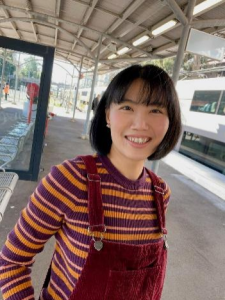
Graduating from the University of Sydney in 2023, Sophia Huei-Ling Chen will soon be joining Academia Sinica at the Institute of Chinese Literature and Philosophy. Her research interest lies in queer literature as well as migrant literature. Currently, her project examines queer migrant writers from Taiwan.